
A product manager asks an AI agent to draft a release plan. The agent recommends a Friday launch because the implementation is complete. The security lead, however, approved only a limited pilot pending a data-residency check; that decision lives in a separate document. A human reviewer catches the mistake and sends a correction through chat. Next week, another agent makes the same recommendation. The team has had plenty of conversations, but the learning never became shared context.
This is a coordination problem, not a chat-interface problem. An effective human–AI team needs a way to remember what was agreed, distinguish suggestions from commitments, and make the relevant knowledge available to the next participant. A conversational history is useful evidence; it is not automatically a durable organizational rule.
Collaboration creates handoffs, not just messages
Think of a release moving through product, engineering and security. The product manager approves a scope; engineering implements it; an agent drafts a rollout checklist; security adds conditions. Every handoff changes what the next participant is allowed to assume. Humans often carry those constraints implicitly because they were in the meeting. Agents typically start from the context they have been given and cannot infer the missing conversation reliably.
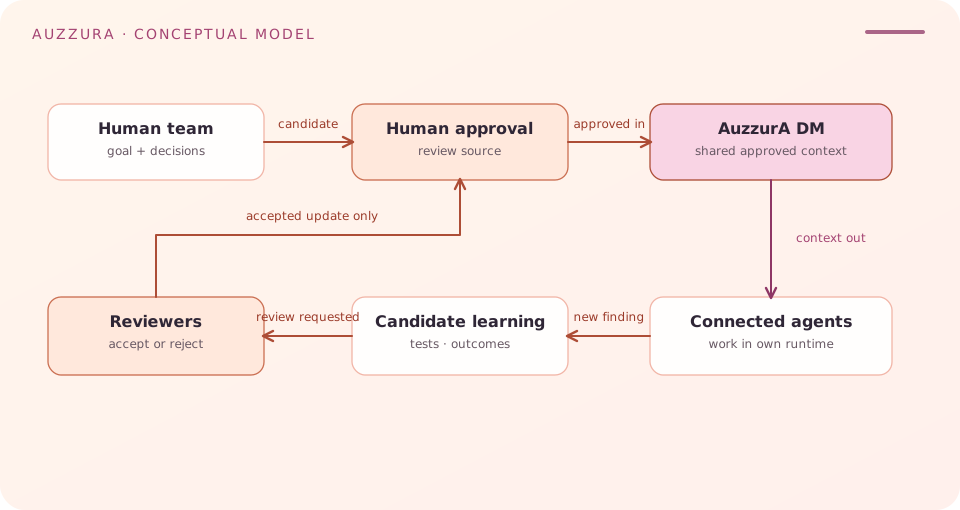
A durable handoff therefore needs two paths. Before work, the participant receives the current, relevant and permitted decisions and rules. After work, new findings or proposed changes return for review. An agent might notice a failing integration test; it can propose that the team revisit an assumption, but it should not grant itself authority to rewrite the organization’s rollout policy.
A useful model of shared state
Separate temporary task state, experiential memory and approved team knowledge. Task state answers “what is happening now?” and can include drafts or unreviewed tool results. Episodic memory answers “what happened last time?” and must carry its conditions. Approved knowledge answers “what has the team committed to, and where does it apply?” These layers interact, but they do not deserve the same trust level or audience.
For our release, the team could preserve a decision record: “Pilot only until security validates EU data residency,” linked to the risk assessment and approving owner. The coding agent receives that constraint; the communications agent sees the permitted public implication; the security reviewer sees the full evidence. One shared workspace does not mean every participant sees every source.
Where DM helps the team collaborate
DM provides reviewed Decisions, Rules and Skills as shared context for human and AI participants, with source evidence and scope. A project lead can retrieve why a launch restriction exists; a connected agent can request the approved constraints relevant to its task through supported interfaces. The candidate-review workflow lets people turn useful observations from documents or agent work into reviewed records instead of leaving every correction as a disposable chat reply.
This matters when participants and tools change. DM does not replace the product manager’s authorization, the security system’s access controls, or the agent runtime that executes a task. It helps the next participant receive the context necessary to honor those boundaries. Memory/episodic integrations exist as a partial, entitlement-gated path and must not be described as universally active.
Start with one repeated correction
Find a correction your team has made twice to an agent or a new employee: “Never deploy this service before this review,” or “This interface is intentionally asynchronous.” Trace where that knowledge currently lives and whether another participant can retrieve it next week. If it depends on the same expert repeating the sentence, the organization has a shared-context gap. Address the gap by creating a reviewable record with evidence and a scope, not by simply saving a longer conversation.
What changes when the team is under pressure
A crisis exposes the difference between shared context and a shared chat transcript. During an incident, the on-call engineer may approve a temporary workaround. The customer team needs to know whether a service is degraded, but should not automatically inherit sensitive root-cause details. The release agent should know that the workaround expires after the incident and must not become the next deployment template. Each participant needs a different view of one evolving decision. Sharing all raw messages would be both noisy and potentially unsafe.
This suggests a practical rule: when a message changes a commitment, constraint or escalation path, capture it as a candidate decision with an owner and review trigger. Keep the complete incident report as evidence. Give each participant the record appropriate to its role. The cost of doing this is a short review; the benefit is that the organization can resume work without relying on the one person who remembers the final conversation.
Sources
Put shared context to work.
DM is AuzzurA’s Beta product for human + AI teams. Sign up or sign in through the DM portal.