
An AI agent can read a codebase and still recommend the wrong architecture. The missing fact may not be in the code at all: a customer contract changed a retention requirement, security rejected an alternative, or a team learned that a migration fails under a specific configuration. These are examples of organizational knowledge—the local facts and decisions that make technically possible work appropriate for a particular organization.
The challenge is not that everything must be moved into a giant new knowledge database. Most organizations already have abundant documents. The challenge is deciding which knowledge must be explicit and reviewable, which may remain in its source documents, and how both can reach the right person or agent at the right time.
Why knowledge becomes fragmented
Follow one product change. The request starts in customer email. The requirement is clarified during a sales call. Product creates a Jira epic. Engineering debates trade-offs in a design review. Security raises an exception in chat. The code changes, but the reason for choosing that implementation remains in several separate conversations. None of those systems is necessarily defective; each optimizes for its own job.
A new teammate—or a coding agent connected to Jira—can recover the list of tasks while missing the final constraint. Search retrieves fragments, perhaps even all of them, but the fragments may disagree. Retrieval alone does not tell the reader whether the rejected proposal or approved alternative should guide today’s implementation.
Distinguish documents, experiences and approved choices
A document is evidence. It can explain a proposal, specification or incident in detail. An episode is a time-bound experience: “This migration failed on the staging cluster with driver version 3.” A decision is a reviewed statement with an owner and scope: “Use driver version 4 in production until the compatibility issue is resolved.” These categories overlap in practice, but making them explicit helps avoid promoting a temporary observation into universal policy.
For high-impact decisions, structure at least the statement, rationale, evidence links, affected scope, owner/approver, status and revisit conditions. For working instructions, structure the rule and where it applies. Preserve the longer narrative, meeting transcript and technical analysis in their original tools and link back to them. Not every page deserves an extracted object; over-structuring creates maintenance overhead and can hide nuance.
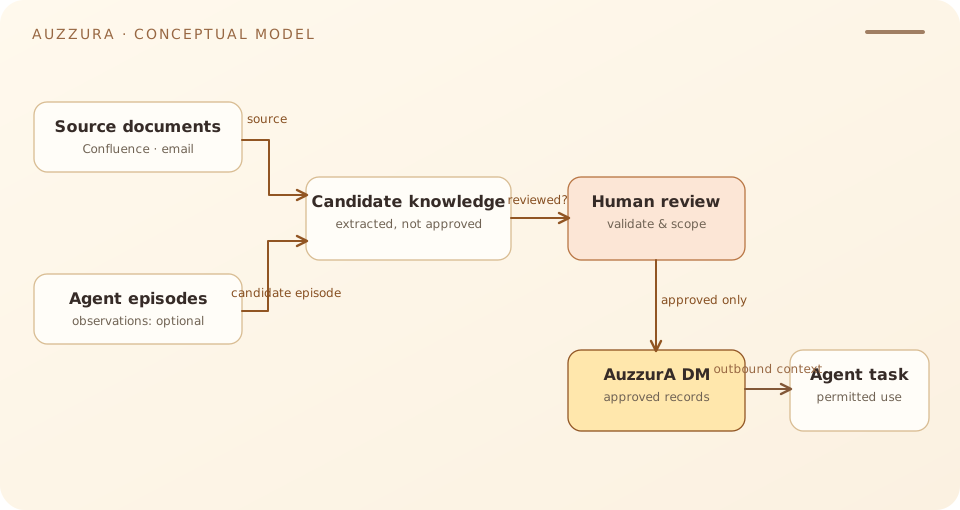
From documents to agent-usable knowledge: a concrete pipeline
An organization’s knowledge base often optimizes for findability: people can search a document title, open an article and infer what it means. Agents require a more explicit contract when the retrieved text will affect an action. The source must be attributable, the claim must have a known state, and the relevant scope must travel with it. Otherwise a helpful summary is easily mistaken for a binding instruction.
Take a migration plan discussed in a meeting, refined in a ticket and later approved by architecture review. The documents remain useful evidence. The reviewed organizational record should identify the selected migration approach, the alternatives rejected, why the team accepted the trade-off, the affected services and environments, and the approving role. Only then can a later agent distinguish “the team considered this” from “this is the currently approved choice.”
A practical capture → structure → validate → govern → activate pipeline does not mean automating authority. Capture keeps provenance and access boundaries; structure identifies candidate decisions, rules and reusable skills; validation checks agreement with cited evidence; governance assigns ownership and human approval; activation supplies task-specific approved context. Learning from later work returns to review as evidence, not as silently updated policy.
This also suggests what not to structure. Meeting transcripts, raw issue logs and long design explorations may remain documents. Promote the parts that must survive handoffs—approved constraints, decisions and reusable procedures—into typed records. The system should support the original evidence link, rather than pretending that a structured summary makes all background material unnecessary.
From “found” to “valid for this task”
Imagine an agent preparing a release to the EU environment. It retrieves an approved deployment guide for the US cluster and an outdated exception that once allowed skipping a review. Both may be semantically relevant to “deploy the service.” Neither should automatically guide this release. The agent needs to know the environment, actor, currentness and whether a newer record superseded either instruction.
The correct sequence is therefore: find candidate evidence, distinguish discussion from commitment, verify the status and scope of what is approved, and assemble the minimum relevant context. If sources conflict or ownership is unclear, surface the gap rather than generate an authoritative-sounding compromise.
Shared memory and organizational knowledge are different trust levels
Shared memory can be useful without being authoritative. An agent can record an experiment, a temporary workaround or a preference so another agent can continue the work. Yet visibility does not confer approval. If a workaround is copied into a common memory store and later retrieved as a team standard, the architecture has crossed a trust boundary without noticing.
An important design distinction is between private experience, shared evidence, candidate learning and governed knowledge. Private memory may include user-specific context that should never be visible to another person. Shared evidence can be inspectable to authorized collaborators but still be disputed or incomplete. A candidate statement is a proposal, not a decision. An approved decision or rule carries identifiable responsibility, scope and lifecycle; it can be delivered to a connected agent when the next task matches.
For instance, Agent A discovers that disabling a cache makes a migration pass in staging. Agent B should not treat “disable cache” as production architecture policy. It can use the observation as evidence and propose a scoped procedure. A responsible reviewer can accept, limit or reject that proposal. The historical test result stays available, but the organizational rule becomes valid only through review.
This distinction is also why an optional episodic-memory feature should not be described as the same thing as DM’s governed core. AuzzurA DM’s durable Decisions, Rules and Skills have a human approval boundary. The purpose is to preserve organizational reasoning while keeping agents able to learn from—but not automatically govern—their own experiences.
How AuzzurA DM makes this usable
DM is designed to sit across existing work systems, not replace Confluence, Jira, email or repository documentation. Teams can bring selected evidence into a review workflow, turn important candidate decisions into approved records, and retain their rationale and lineage. Search and Ask DM help people find the decision behind a document; Prepare Context helps connected agents consume the applicable Decisions, Rules and Skills for an actual task. That is the product’s role in a real knowledge-fragmentation problem: less repeated reconstruction and fewer technically correct but organizationally wrong recommendations.
The architecture can also draw on Graphify-backed repository intelligence to understand code and dependency relationships. The Mem0-related memory path remains partial and entitlement-gated; it is not a universal, automatic record of every agent experience. DM does not claim that all organizational truth can be extracted from tools without a human defining what becomes trusted.
What to structure first
Choose one recurring decision question: “Why is this API asynchronous?”, “Which data-retention exception is current?”, or “What should a newly onboarded agent know before touching billing?” Identify the documents that support the answer, create a small reviewed decision record, and link the source artifacts rather than copying them all. Then let someone unfamiliar with the history retrieve the result. If the person can reconstruct the choice and its current scope without the original expert, the structure is doing useful work.
The long-term target is not the most comprehensive document warehouse. It is the smallest reliable set of facts and decisions that lets work continue correctly across people, tools and time.
Sources
Put shared context to work.
DM is AuzzurA’s Beta product for human + AI teams. Sign up or sign in through the DM portal.