
An agent solves a deployment problem on Monday and encounters a similar failure on Friday. What should it remember? It may need the command it ran, the fact that the failure occurred under a particular configuration, the current deployment policy, and the steps that reliably fixed the issue. Those are different kinds of information. Treating them all as undifferentiated “memory” makes an agent more likely to repeat a mistake—or to generalize an accidental workaround into a rule.
Memory in AI systems is not one universal database. A useful design distinguishes working, episodic, semantic and procedural memory according to what the information represents and how it should influence later work. In teams, another dimension matters just as much: whether the memory is private experience or approved knowledge shared across people and agents.
Working memory: what matters in this run
Working memory is the active task state: the user’s request, relevant files, recent tool results, partial plan and immediate constraints. It helps the agent continue a multi-step action. It is also limited and potentially noisy; a large context window does not guarantee every included detail will be used correctly.
For a deployment incident, working memory may contain the error message, the current service version and the candidate rollback steps. Most of it should not become long-term organizational memory. A temporary log line or unreviewed hypothesis does not deserve to shape every future deployment.
Episodic memory: what happened before
Episodic memory records experiences, often including sequence and outcome. “Last time we used configuration B against API version 3, validation failed with error X” is a useful episode. It can save another agent from repeating an expensive experiment. But it is not equivalent to “Never use configuration B.” The cause may have been a transient dependency or an environment-specific issue.
An episode is most reusable when it records the configuration, environment, time, evidence and observed result. In a multi-agent team, an episode from Agent A may become helpful context for Agent B—but a reviewer should decide whether it supports any durable team rule.
Semantic and procedural memory: facts and practices
Semantic memory captures learned facts and concepts, such as “the customer data region for Product X is EU.” Procedural memory captures how to perform tasks, such as the steps to prepare a release or run a smoke test. In an organization, these can overlap with approved Rules, Skills and Decisions. A reliable system needs to show whether a fact is merely recalled from experience or has been verified and accepted for a defined scope.
Imagine that the release procedure includes a manual security sign-off. The agent may remember the steps and execute the preparatory work, but cannot infer that it is authorized to provide the sign-off. A procedure tells it what the workflow is; authority determines which participant may complete the gated step.
Why more memory can make a team less reliable
Persistent mistakes are often worse than transient ones. If an agent stores a confident but incorrect explanation as “fact,” later runs may repeat it without consulting the source. If an internal exception is shared without permission and scope, it can leak or be misapplied. If a procedure has been superseded, an agent that remembers it vividly may still be operationally wrong.
A memory lifecycle should therefore provide retention decisions, provenance, freshness checks, permission boundaries and a path for supersession or correction. Human review becomes especially important at the point where a local experience is promoted into organization-wide guidance.
Where decision memory fits in the taxonomy
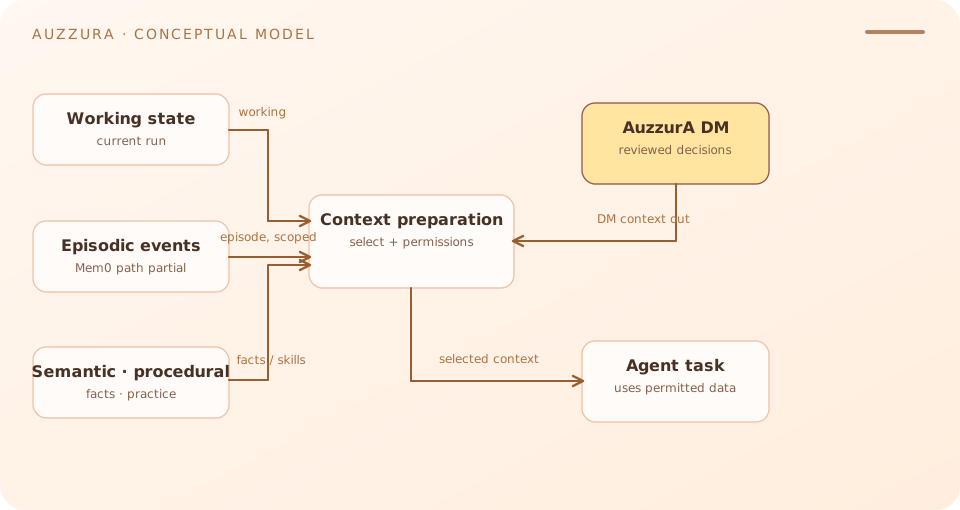
Many teams use “AI memory” to mean five different capabilities. Episodic memory remembers that something happened; semantic memory stores facts and concepts; procedural memory captures a way of working; working memory is the active context of the current run; and governed decision memory records the organization’s approved choices and why those choices still apply. Structured storage is not a competing sixth human-like memory type: it is a representation technique that may be applied to any of them.
Imagine that an agent remembers a failed deployment from Tuesday. That is episodic evidence. It may recall the general principle that schema migrations need compatibility safeguards—that is semantic knowledge. A migration runbook is procedural. But the team’s explicit decision, “Production migrations to service X require the feature flag to be disabled until verification Y completes,” requires an approver, project scope, rationale and lifecycle. An incident summary alone cannot promote that statement into policy.
An architecture should therefore ask two separate questions before persisting knowledge: what kind of information is this? and who is entitled to treat it as authoritative? The second question matters when one agent’s experience becomes another agent’s instruction. A private conversation or an experimental workaround can be useful evidence without becoming a reviewed standard for the whole organization.
A useful design table is: event → episodic record; stable fact → semantic source; approved repeatable workflow → skill or procedure; approved choice/constraint → governed decision or rule; active request → working context. Every category still needs appropriate access controls, freshness checks and provenance.
How AuzzurA DM fits without conflating the categories
DM’s core live value is reviewed, reusable team context: Decisions, Rules and Skills with evidence, ownership and scope; Search and Ask DM for recall; Prepare Context and supported agent interfaces for task-specific use. That helps a developer or agent determine what the team has approved rather than relying solely on private notes. Graphify-backed repository intelligence can contribute live code and dependency relationships when the task is architectural.
DM also has a Mem0-based memory integration that is partial, entitlement-gated and not enabled by default. It is therefore incorrect to claim that DM automatically captures every agent episode or provides universal long-term memory today. The design direction is to combine useful experiences with durable, reviewed organizational knowledge while preserving which items are observations versus instructions.
A practical memory design exercise
Take one recurring agent mistake and classify the information that would prevent it. Is it a task reminder, a historical episode, a factual constraint, or an approved practice? Record where the evidence came from, how long it should remain useful and who is allowed to share it. The classification is not academic: it tells you whether the right fix is a short-lived note, an episodic store, a reviewed rule or better context selection.
Sources
Put shared context to work.
DM is AuzzurA’s Beta product for human + AI teams. Sign up or sign in through the DM portal.