
An agent can accept hundreds of pages of documentation, an entire issue history and a large repository snapshot. It still recommends an obsolete deployment method. The limitation is not simply how many tokens fit. The agent was given both the current and the outdated instructions without a reliable way to distinguish them. More context can increase coverage while leaving authority and relevance unresolved.
Large context windows are valuable. They can support long documents, complex coding tasks and fewer retrieval interruptions. But context capacity is not the same as context quality. Teams need to decide which information belongs in each task, which records remain current, and what to do when sources disagree.
The problem is selection, not only storage
Suppose a release agent receives a 200-page collection of engineering notes. Deep inside are two contradictory rollback procedures. One applied to last year’s Kubernetes cluster; the other was accepted after a new incident. Both contain the same service name and similar commands. Simply pasting both into a larger prompt does not reliably signal which one governs production. A source-selection rule could have resolved that before the model started planning.
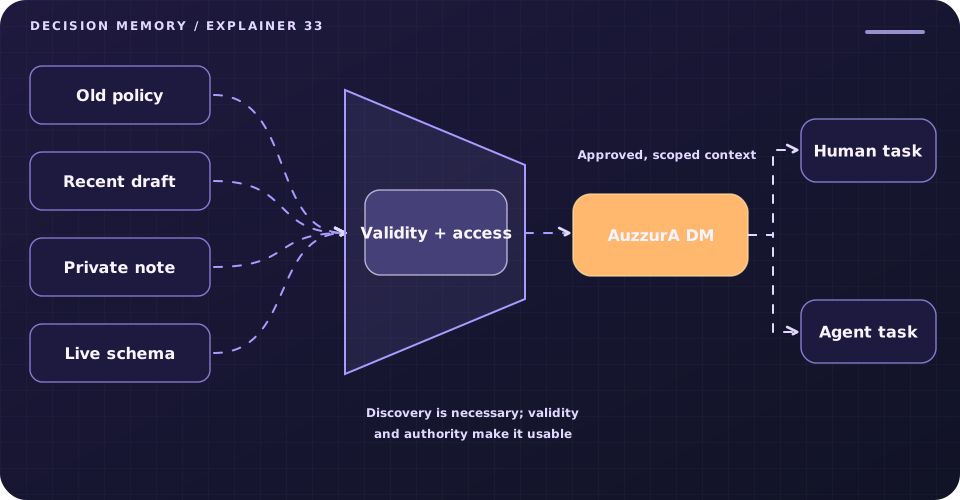
This is why retrieval still matters even with long-context models. Search narrows the candidate set. Metadata and review status distinguish valid instructions. Task scope—service, environment, user and objective—helps exclude irrelevant material. Context engineering then composes a focused packet instead of treating the whole archive as equally useful.
More tokens carry measurable operational costs
Larger prompts can increase latency and input-token costs. They can also complicate debugging: if the agent ignored a critical rule buried among dozens of examples, it is difficult to say whether the rule was absent, drowned out or contradicted. Research and engineering guidance on context engineering emphasize attention as a limited resource and support selective retrieval and progressive disclosure rather than loading everything up front.
This does not mean every long prompt fails or that all agents should use tiny contexts. It means designers should test whether additional context improves the specific outcome, not assume that maximum input size is inherently safer.
Compose context around the work
For a production rollout, start with the task: deploy service X to EU production as actor Y. Gather the current deployment procedure, the relevant security decision, the latest architecture constraint and supporting evidence. Exclude a superseded staging workaround even if it is semantically similar. If a policy conflicts with the task, surface the conflict early. Allow the agent to retrieve additional documents on demand rather than packing them all into the opening prompt.
The difference appears at the next handoff. A new agent should receive the same current approved constraints without reading every historical conversation that produced them. That is continuity through selection and provenance, not continuity through unlimited transcript retention.
Where DM changes the economics of context
AuzzurA DM maintains reviewed Decisions, Rules and Skills with the scope and evidence needed to select relevant organizational context. Search and Ask DM let humans reconstruct reasoning; Prepare Context and supported MCP-facing tools allow connected agents to request applicable knowledge for a task. Live Graphify-backed repository intelligence can add dependency context for coding work without treating the entire codebase as raw instructions.
The value is not a claim that DM guarantees lower token bills or perfect correctness. Those outcomes need controlled benchmarks. It is a concrete way to avoid repeatedly rediscovering decisions, prevent known-superseded guidance from being treated as current, and reduce the amount of uncurated material agents must interpret on their own. The Mem0 memory integration is partial and off by default, not a universal long-context replacement.
Test with a fixed task and three context sets
Run the same realistic task with: (1) a long raw documentation bundle, (2) a retrieval-selected set of documents, and (3) retrieval plus explicit current decisions and scope. Compare validity of the final output, omitted constraints, tokens and investigation time. If the larger prompt wins, use it. If the focused, approved context wins, you have evidence that selection matters more than size for that workflow.
When a long context window is actually the right answer
Some tasks require broad simultaneous comparison: reviewing a contract against many clauses, analyzing a complex change set, or synthesizing a long incident history. A large context window can be the simplest effective option. The mistake is turning that convenience into an assumption that every relevant source has equal status. Even when the whole corpus fits, the agent still benefits from clear labels for current policy, obsolete examples and sources it may not use.
A defensible design can combine large context with progressive disclosure. Provide concise current constraints up front, then let the agent request detailed evidence when it needs to justify a choice. Log the source versions used for important decisions so the team can investigate a questionable result. This keeps the benefits of long-context models while reducing the chance that an attractive but obsolete paragraph guides the work.
Sources
Put shared context to work.
DM is AuzzurA’s Beta product for human + AI teams. Sign up or sign in through the DM portal.