
A new coding agent searches a company’s technical documentation and finds three answers to the same question. One is a proposal in Confluence, one is a workaround recorded in a support ticket, and one is a reviewed architecture decision. All three match the query; only one should guide the production change. The difficulty is not finding information. It is knowing what is permitted, approved and applicable for this task.
That is the practical meaning of context governance: the rules and review process that determine how evidence becomes trusted shared knowledge and how that knowledge is selected for use. It should reduce mistakes and repeated clarification, not burden every meeting with a new compliance ceremony.
The three things an agent should not confuse
Raw evidence is a document, discussion, ticket, transcript or tool result. It can be valuable without being correct or current. A candidate interpretation is an extracted potential decision or rule that still needs verification. Approved knowledge is a reviewed statement with scope, ownership, status and evidence. Treating these as interchangeable creates a familiar error: an agent confidently repeats the last interesting sentence it found as if it were policy.
For example, a meeting note says “consider disabling retries during migration.” An assistant extracts “disable retries.” A developer applies it to production even though the meeting ended with “investigate and return next week.” The defect began at the evidence-to-approval boundary, not the wording of the final prompt.
Three questions before context becomes trusted
Reviewers often use “relevant” as a synonym for “correct.” That shortcut hides three different tests. Provenance asks where the claim came from and whether the source and extraction can be inspected. Authority asks who was empowered to commit the team and whether that approval happened. Freshness asks whether the statement remains effective for the current task, not merely which document has the most recent timestamp.
Take the retry-policy example. A dated incident report may be the most reliable evidence about what broke, but it is not necessarily the current rule. An engineer’s newest message might propose a change without approving it. A reviewed decision can be older yet still valid until a successor is accepted. The right answer emerges only when source, approval, supersession and task scope are evaluated together. If those signals conflict, return an uncertainty or review request instead of hiding the disagreement.
These checks must also work after a task. When an agent reports “disabling retries fixed the test,” retain it as an observation with environment and evidence. A human may use that observation to propose a scoped exception; only a reviewed update should become reusable organizational guidance.
Raw data is evidence—not yet task context
A recurring failure begins with a category mistake: an organization lets raw data or an AI-extracted sentence masquerade as approved knowledge. A transcript records a discussion. A ticket records a task. A retrieval result records what matched a query. None proves that a responsible person chose the proposed action for the relevant scope.
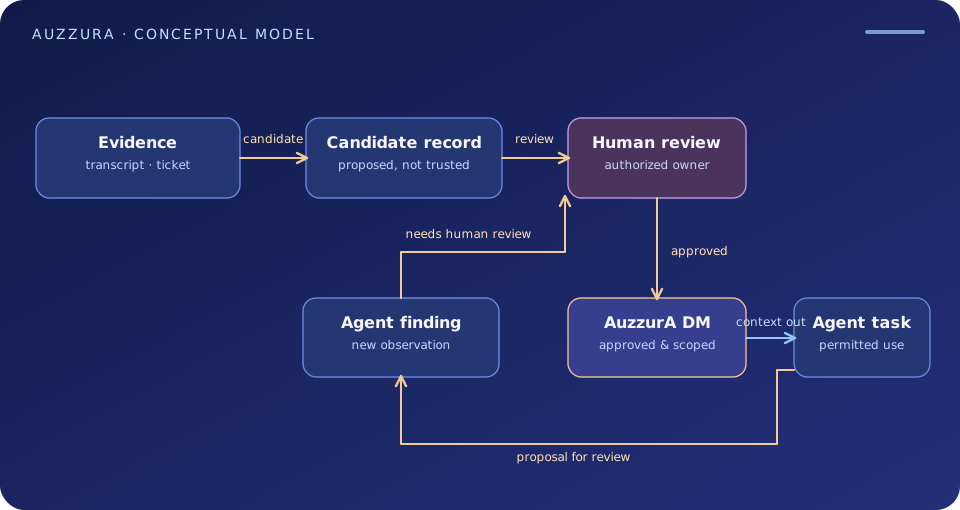
The safer progression is source → evidence → candidate → reviewed decision/rule → applicable task context → outcome. Each transition carries a distinct question. Did the source really say this? What uncertainty or contradiction remains? Who is permitted to approve it? For which team, repository, customer or environment does the result hold? When must it be reviewed again?
As an example, a meeting note reads: “We should consider disabling retries during the migration.” An extraction model might summarize it as “Disable retries.” That is not a reliable operating rule. The resulting candidate must still be checked against the source and other constraints, scoped to the migration window, and reviewed by the accountable human. If approved, it can be supplied to an agent working on that migration. If the evidence is ambiguous, the system should preserve the ambiguity instead of laundering it into certainty.
A useful governance system makes these transitions inspectable. A later incident should allow the team to reconstruct not just what the agent saw, but whether a source was evidence, a proposal or an approved instruction at the time of use.
Make the lifecycle visible
A workable process begins by capturing sources with links and timestamps. AI can propose a structured decision, including the statement, rationale, alternatives and uncertainties. The responsible owner reviews whether the group actually committed to it. Once approved, the record can guide relevant work. If a later incident or design change invalidates its assumptions, it should be reopened or superseded—not quietly edited until the history disappears.
For a data-retention choice, this means the next engineer can answer: “The team chose the document store because of retention controls; the SQL option was rejected; this applies to the EU upload service; the decision is still current.” That is more useful than recovering an unstructured transcript and guessing which side won.
The knowledge lifecycle continues after approval
Approval is not the end of knowledge management. Policies change, exceptions expire, technology moves and test results reveal assumptions that no longer hold. A credible lifecycle includes create, validate, review, activate, observe, refresh and retire—with explicit supersession rather than silent overwrite when history matters.
Suppose a decision initially authorizes a temporary API compatibility fallback during migration. When the migration completes, that exception should either expire or receive a new review. An agent starting the next task must not see both the old fallback and the new standard as equally current. The evidence that justified the old decision remains useful for audit and troubleshooting even after its instruction stops applying.
Lifecycle also affects the way results flow back from execution. A deployment failure, support escalation or new test is evidence that an approved assumption may be wrong. It should create a review candidate, not an automatic change to the governed rule. Human authority governs whether the record is superseded, reopened or left current with a documented exception.
Track effectiveness with operational questions: How often does an agent receive a superseded rule? Can a reviewer explain why a record was current at a given moment? Does an expired exception disappear from applicable context without destroying its history? Can the organization trace a revised choice back to the event that triggered the review? These are lifecycle measurements, not simply document count or embedding recall.
Relevance is only the first filter
An agent may retrieve the correct topic from the wrong project. A recent comment may be a rejected proposal. A historically valid rule may be superseded. A user may have permission to read a source but not to see another team’s restricted notes. Eligibility requires more than semantic similarity: check scope, status, authorizing owner, effective time, permissions and conflicts. Sometimes the right answer is “the sources disagree; ask the owner,” rather than a confident instruction.
The same test should apply in the other direction. When an agent finishes a task, it may learn something worth preserving. That observation is evidence for a new candidate, not automatic organizational knowledge. A review gate can be assisted by other AI tools, but the authorized person or established approval process retains responsibility.
How DM turns governance into useful work
DM provides a workspace for reviewed Decisions, Rules and Skills, grounded search, candidate review, and scoped context preparation for human and AI participants. The immediate value is practical: reduce re-deciding, help new engineers understand why a constraint exists, and supply the right approved knowledge before a connected agent changes code or proposes work. DM’s evidence links and status make it possible to inspect a decision instead of accepting an unsupported summary.
Graphify-backed repository intelligence adds codebase relationships for technical tasks. Mem0 episodic memory remains partial and gated; neither capability means that DM automatically knows every document or enforces every downstream runtime action. The boundary stays clear: DM helps determine what knowledge is trusted and appropriate; the connected systems handle execution under their own controls.
Begin without a governance program
Choose one repeated dispute—an API choice, a security exception, a pricing rule. Capture the final statement, rationale, approver, scope and revisit trigger in one place. Link the primary evidence. Have a new colleague or agent request the current decision. If the question that used to take a meeting can now be answered with sources, context governance is already paying for itself.
Sources
Put shared context to work.
DM is AuzzurA’s Beta product for human + AI teams. Sign up or sign in through the DM portal.