
An agent makes a plausible change to a payment service and every unit test passes. During review, an engineer spots the problem: the change uses a deprecated authentication pattern. The agent had access to the repository and a searchable documentation system, so why did it choose the old rule? Without knowing which context was selected, which version was shown, and what was excluded, the team is left guessing. A successful trace of API calls does not answer that question.
This is the difference between observing what an agent did and observing what information shaped its decisions. Both matter, but they require different evidence. A tool trace tells us which search or write action occurred. Context observability tells us what the agent could see at the moment of that action and why that information was considered applicable.
Start with the incident, not the dashboard
Suppose the instruction to use short-lived service tokens lives in an approved security decision. An older Confluence page documents long-lived tokens because they were once used for a test environment. When a coding agent searches “service authentication,” both documents look relevant. The old page has more examples and is copied into the agent’s context. The result is a technically coherent implementation of the wrong organizational choice.
A team investigating this failure needs a timeline: the agent’s task and environment, the documents returned by retrieval, the versions of each document, the eligibility checks, the final context delivered, and the resulting code change. Merely storing the prompt or the entire chat may still miss what the context assembler silently discarded. The investigator also needs to distinguish an authoritative instruction from an example of historical behavior.
The context decision record
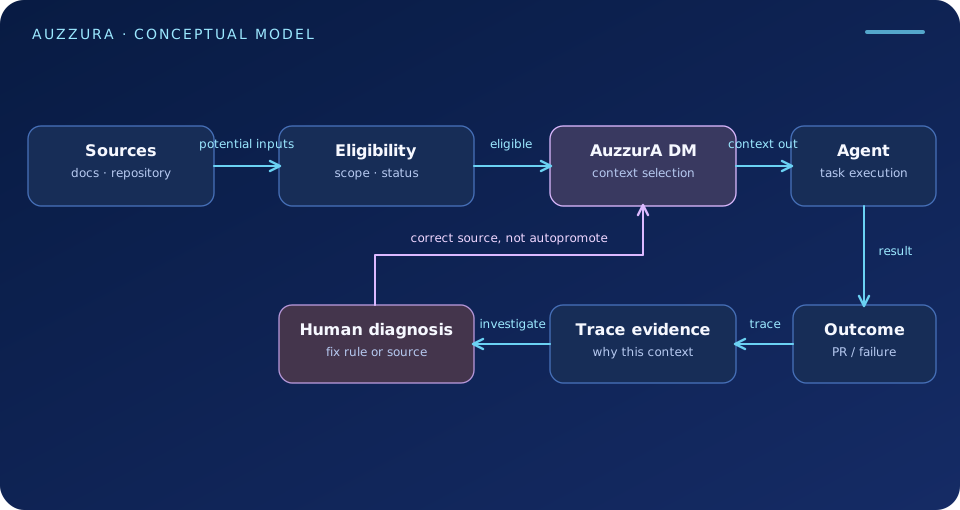
A useful context decision record connects task → candidate sources → selection reasons → delivered context → outcome. For every source, capture a stable identifier, provenance, version or timestamp, scope, and status. For every selection, capture whether the item was included, excluded, or held for clarification, plus the reason. Record the actor or service principal used to obtain the information; it matters whether an agent was acting for a developer or a production operator.
For example, the incident above could reveal: “Approved Decision SEC-12, current for production, excluded because its project identifier did not match the agent’s task scope; Confluence page AUTH-OLD included because its text matched strongly.” That points to a scope-mapping defect, not a failure of model reasoning. The fix might be a better source binding, stricter defaults, or an explicit missing-context warning—not simply a bigger prompt.
How it differs from conventional agent tracing
Runtime observability answers whether the agent called an MCP tool, how long it took, whether it succeeded, and what response it received. Context observability also asks whether an approved rule was in scope, whether a superseded decision was mistakenly included, and whether a relevant source was withheld by permissions. These are complementary records. The first explains execution mechanics; the second explains the context policy and factual inputs behind an outcome.
The distinction matters after an incident. A security reviewer may want to know whether sensitive material was returned to an unauthorized actor. An engineering lead may want to know whether a deprecated ADR contaminated a design recommendation. Those questions require retaining enough evidence to audit a decision without indiscriminately logging sensitive raw documents or model conversations. Logs themselves need permission controls and retention boundaries.
Where AuzzurA DM contributes
DM helps a team establish what should count as trusted context before the run. It keeps reviewed Decisions, Rules and Skills alongside ownership, applicability and source links; Prepare Context and connected-agent access can supply selected, permitted knowledge for a specific task. This complements trace systems that observe execution. If a team can connect an agent’s run to the DM context it requested, investigators can ask whether the right knowledge was available and whether a conflict or outdated record was visible.
The benefit is concrete: instead of asking a colleague to reconstruct what the agent should have known, a reviewer can examine the approved decision, its evidence, its scope and its current status. DM is not presented here as a universal tracing system or an enforcement point for every downstream tool. Instrumentation of actual prompts, runtime tool calls, and complete selection decisions must still be verified in the connected agent stack; this article describes an operating pattern, not blanket shipped observability.
A small test worth running
Take one agent task that produced a questionable result. Collect the tool trace, the exact task scope, and the current approved engineering decision. Can a reviewer tell whether the decision was offered to the agent, ignored, or never retrieved? If the answer is “we don’t know,” add a context-decision receipt at the retrieval/selection boundary. Measure the time required to explain one failure before and after. The goal is not more telemetry; it is a faster, defensible explanation of why this agent had this context.
Sources
Put shared context to work.
DM is AuzzurA’s Beta product for human + AI teams. Sign up or sign in through the DM portal.