
A developer asks an AI coding agent to extend an API. The agent reads the repository, follows the ticket and produces a valid implementation. It still makes the wrong architectural choice, because a design review months earlier rejected that approach for a security reason. The decision existed—in a meeting summary, a Confluence page and someone’s memory—but the agent never received it in a usable form.
AuzzurA DM addresses this gap. It is a shared context layer for human and AI teams: a way to preserve approved Decisions, Rules and Skills with their rationale and evidence, and to bring the relevant pieces into the next task. It is not another meeting recorder, a generic chatbot or a replacement for the team’s existing documentation and project-management tools.
Why ordinary documentation is not always enough
Documentation tells people what has been written down. A task tracker tells them what work is assigned. A conversation may capture why two options were debated. Those systems all have value, but the decisive knowledge can remain fragmented across them. When a new person joins or an agent starts without the original conversation, it may discover the outcome without understanding what constrained the choice.
Consider a team choosing between synchronous and queued payments. A prototype succeeds synchronously. Later, engineering approves a queue because a downstream service has a strict rate limit. The Jira ticket is updated to “build queue,” but the reasoning stays in chat. A new agent finds the working prototype and proposes the old approach again. The underlying failure is not poor reasoning about queues; it is missing current organizational context.
What a reviewed decision record preserves
The useful object is compact but more informative than a task status: the decision, rationale, supporting evidence, assumptions, alternatives, scope, owner/approver, current status and later changes. For the payment example, a record might say “Queue refunds for production service X,” link the rate-limit evidence, explain why synchronous processing was rejected and identify the conditions that should trigger reconsideration. A proposal remains a proposal until an authorized reviewer approves it.
The lifecycle also matters. If the downstream service removes the limit, the team can reopen the decision and retain the predecessor rather than overwriting why the queue was chosen. That makes the history useful for both future architecture work and ordinary onboarding.
How a team uses DM in practice
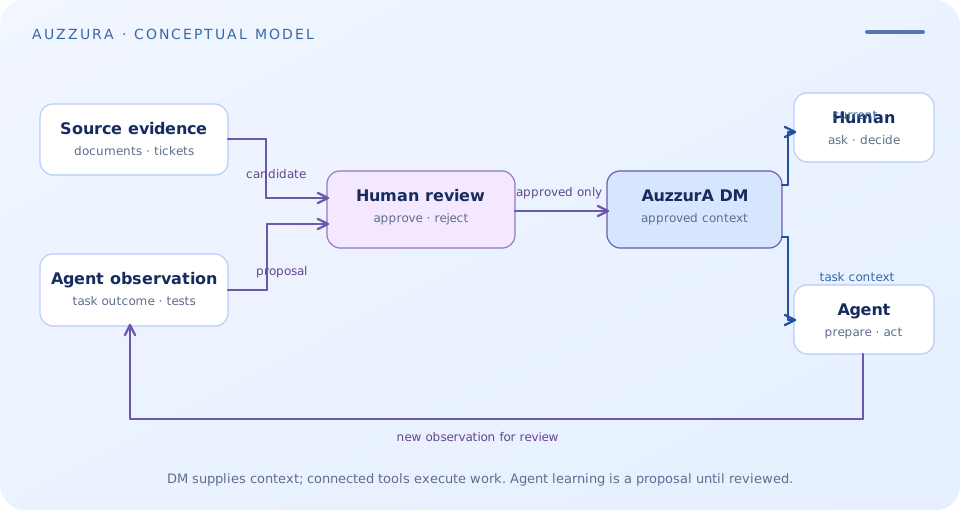
An engineer or product lead can bring selected evidence from relevant work artifacts into a candidate-review workflow. The team reviews what is actually decided and what remains uncertain. Approved Decisions, Rules and Skills then become durable, searchable context. A colleague can ask DM for the rationale behind a choice, while a connected coding agent can request applicable context before implementing a task. The agent still works in its own repository and tools; DM supplies the reviewed knowledge that would otherwise be easy to miss.
This creates a useful feedback loop. New work may reveal that an assumption has failed. Instead of letting the observation disappear into an agent transcript or meeting note, it can be proposed for review and, if accepted, linked as an update to the existing decision. DM does not imply automatic approval of AI output.
Context, repository relationships and memory are complementary
DM also supports repository intelligence through a Graphify integration, useful for code, architecture and dependency relationships. Its Mem0-based memory integration is partial and entitlement-gated, not a default-on recorder of every agent experience. Memory may help with continuity; repository intelligence helps understand the system; reviewed Decisions, Rules and Skills explain what the team agreed to do. DM’s role is to bring the relevant, permitted pieces together for the work at hand.
That distinction helps avoid a familiar trap: a system can retrieve a perfectly accurate historical fact and still make a bad recommendation if it applies the fact to the wrong environment or ignores a superseding decision.
When is DM worth trying?
Start with a team that repeatedly asks “Why did we do it this way?” or sees agents produce work that passes technical checks but misses local constraints. Choose one recurring task, create or identify the current approved decision behind it, and see whether a new person or connected agent can retrieve the reasoning without calling the original architect. If the tool eliminates a repeated explanation while leaving existing workflows intact, it is solving the right problem. Learn more, or create a DM account at https://dm.auzzura.com/login, free to try.
Sources
Put shared context to work.
DM is AuzzurA’s Beta product for human + AI teams. Sign up or sign in through the DM portal.