
From fragmented inputs to approved decision memory.
Decision Memory is a decision-context workspace — not meeting notes, a chatbot, or enterprise search. This walkthrough explains how evidence becomes approved, evidence-backed decision records with rationale, ownership, lineage, and grounded recall.
What Decision Memory reads
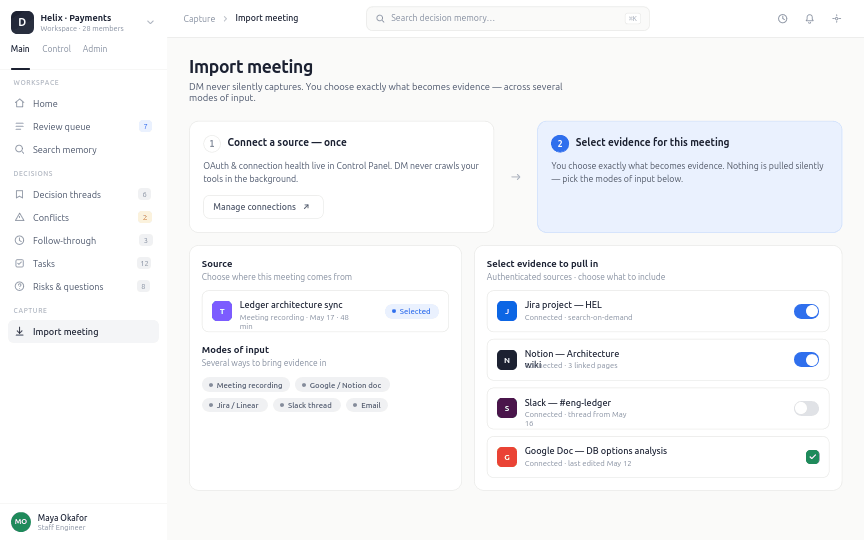
Meetings, documents, tickets, chats, and emails are inputs — not the durable object. Decision Memory connects to sources you choose in the Control Panel. Nothing is crawled silently. You select what becomes evidence for candidate review.
- Meeting transcripts and notes from decision-heavy sessions
- Architecture docs, RFCs, and product briefs
- Jira or Linear tickets tied to scope or technical choices
- Slack or email threads where rationale actually lives
Evidence intake
Intake is deliberate. For each source, you choose what enters the pipeline. Processed evidence routes to candidate extraction — never directly into organizational memory.
Candidate decision extraction
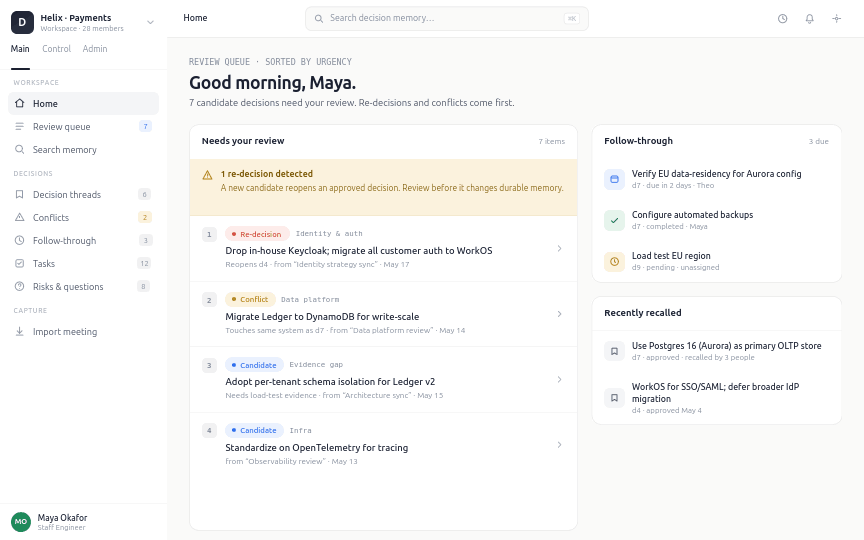
AI proposes candidate decisions from selected evidence — titles, rationale sketches, linked sources, and confidence signals. Candidates surface in the review queue ordered by urgency: re-decisions, conflicts, and evidence gaps first.
Human review and approval
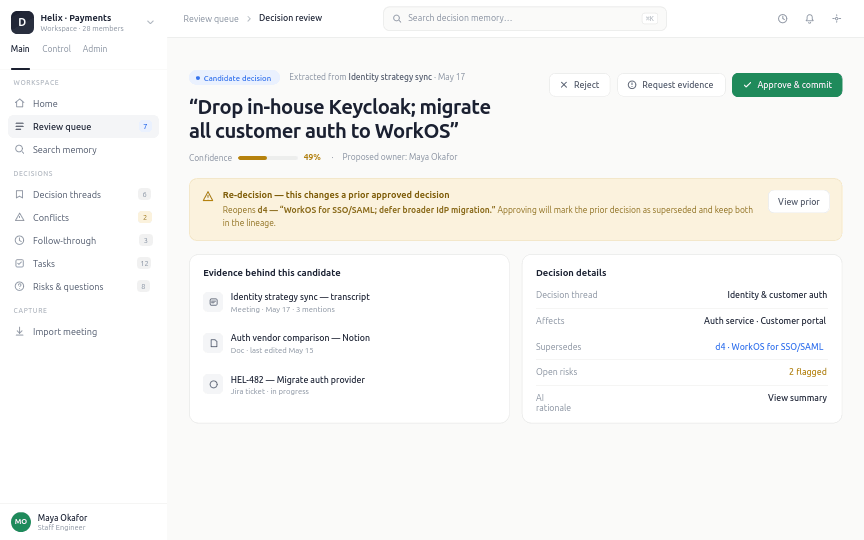
The human approval gate is non-negotiable. Reviewers see the candidate, linked evidence, and any warnings if a prior approved decision may be affected. Approve, reject, or request more evidence. Only approved decisions enter durable memory.
Durable decision context
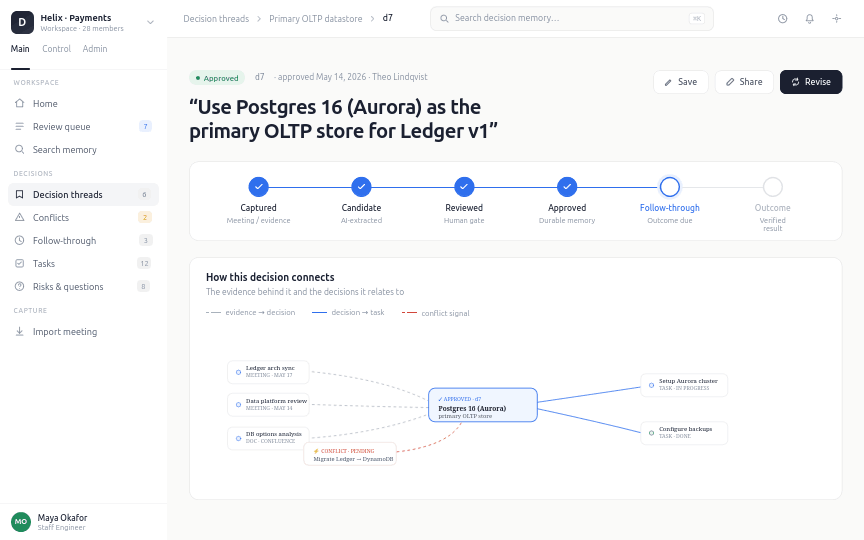
An approved decision record preserves rationale, evidence, ownership, follow-through tasks, outcomes, conflicts, and lineage as a first-class object — designed for recall and governance, not free-text search.
Decision Repository
The Decision Repository is your organizational decision memory — approved records with full context maps. Search, filter, and compare decisions across teams, tools, and time without re-reading scattered meeting notes.
Ask DM — grounded decision recall
Ask DM answers from approved decision records and permitted evidence. Responses cite which decision, who approved it, and which evidence supports the answer. Ask DM does not speculate from raw documents or unrestricted chat history.
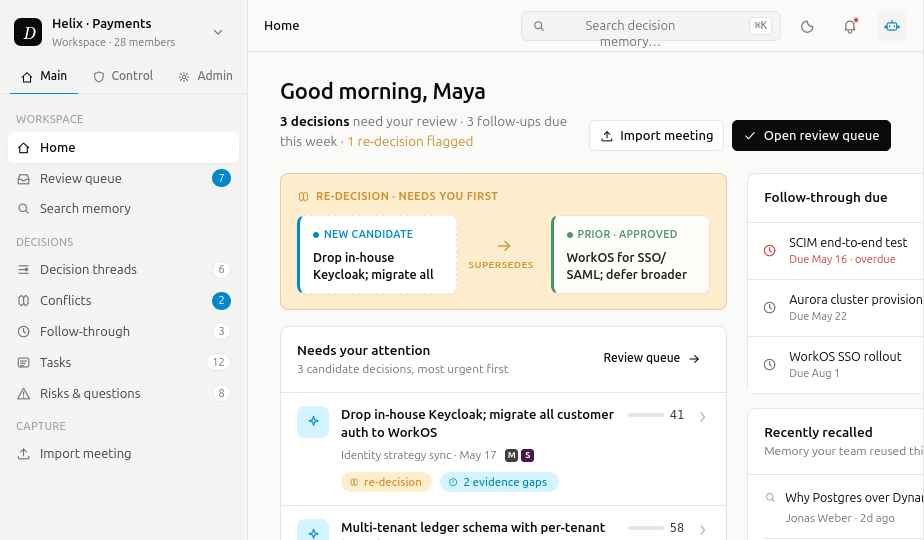
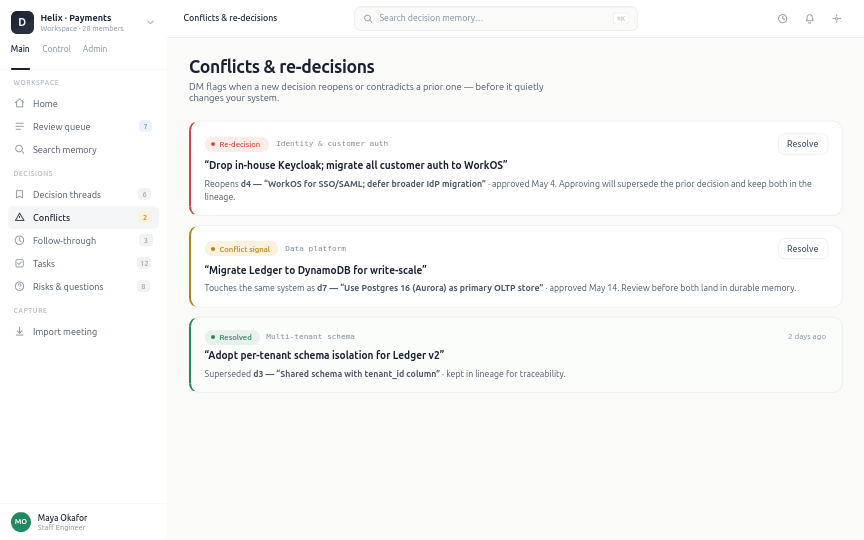
Conflict and re-decision signals
When a new candidate touches an earlier approved decision, Decision Memory surfaces the conflict before approval. Re-decisions, supersessions, and lineage are tracked so teams stop silently undoing prior choices.
Follow-through and outcomes
Decisions do not end at approval. Ownership, tasks, and outcomes stay attached to the record so you can see whether the decision held, what shipped, and what changed in practice.
Security and governance basics
Evidence can be restricted, redacted, metadata-only, or blocked. Recall is policy-aware. Decision Memory is built for organizations where sensitive material and approval boundaries matter — especially as AI tools need trusted decision context.